

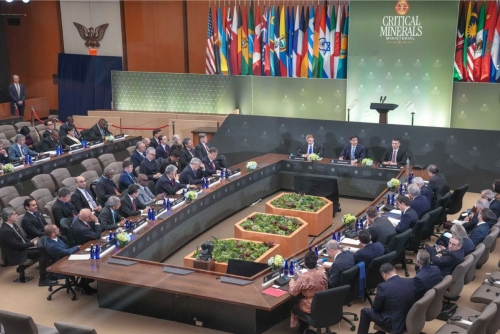
U.S. Pushes Global Minerals Trading Zone to Curb China’s Influence
Email: online@newsofbahrain.com
Washington: The United States has unveiled a major strategy to reduce global reliance on China for critical industrial minerals, proposing the creation of a preferential trade bloc with allied nations that would coordinate pricing and supply policies for materials vital to advanced technologies.
U.S. Vice President J.D. Vance announced the initiative on Wednesday at a summit in Washington, where officials from more than 50 countries including India, Japan, Germany and South Korea gathered to discuss shared challenges in securing raw materials for semiconductors, electric vehicles and defence systems.
Under the proposal, participating countries would agree to price floors and related trade measures designed to protect domestic producers and prevent markets from being undercut by cheaper imports. This coordinated approach aims to strengthen the competitiveness of Western and allied mineral producers and encourage new investment in mining and processing capacity.
The idea comes amid growing concern in Washington that China’s dominant role in mining and processing critical minerals including rare earth elements gives it disproportionate influence over global supply chains. Beijing controls a large share of processing capacity for many of these materials and has at times tightened exports, pushing prices up and sparking shortages in industries from auto manufacturing to clean energy.
“We want members to form a trading bloc among allies and partners that guarantees access to essential materials while expanding production across the entire zone,” Vance said, outlining the goal of boosting supply resilience and reducing vulnerability to external disruptions.
This initiative dovetails with other U.S. efforts, such as a newly announced strategic stockpile of critical minerals backed by federal funding, intended to ensure long-term access to key resources.
In parallel, Washington has begun coordinated trade talks with partner nations, including a bilateral plan with Mexico and trilateral discussions with the European Union and Japan aimed at harmonizing supplier standards and trade policies.
Market reactions were mixed: shares of some U.S. mineral companies declined on news of the bloc proposal, as investors weighed the potential impact of trade interventions and price supports.
Supporters argue that the bloc could unlock private capital and diversify supply sources by offering a more predictable trading environment. Critics, however, caution that price floors and tariffs could elevate costs for manufacturers in the short term and potentially strain relations with China, a major trading partner.
The plan reflects a broader geopolitical push by the U.S. to balance China’s influence in the global economy while strengthening cooperation among like-minded countries on supply chain security a priority as demand for advanced technology inputs continues to grow.
Related Posts