

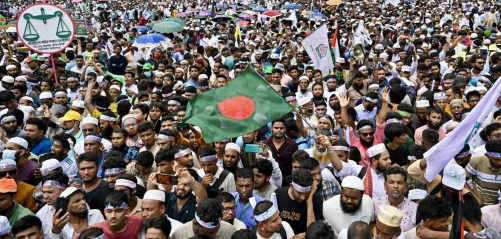
Bangladesh Prepares for High-Stakes Election After Hasina’s Ouster
email: online@newsofbahrain.com
Dhaka/New Delhi: Bangladesh will head to the polls on February 12, alongside a nationwide referendum on reforms, in what is widely seen as the country’s most consequential election in decades. The vote will take place in a dramatically altered political landscape, with the once-dominant Awami League barred from contesting and many voters expressing uncertainty over their political choices.
More than 127 million people are eligible to vote in the election, the first since mass protests in August 2024 ended the rule of former prime minister Sheikh Hasina. The unrest, known as the July Uprising, culminated in Hasina fleeing into exile in India.
Interim government Chief Adviser Muhammad Yunus has described the election-referendum exercise as a “grand festival,” promising the most free, fair and peaceful vote in Bangladesh’s history and the foundation of what he has called a “new Bangladesh.”
However, political analysts warn that the exclusion of a major party and heightened tensions risk undermining the competitiveness, stability and legitimacy of the process.
With the Hasina-led Awami League out of the race, the contest has narrowed primarily to the Bangladesh Nationalist Party (BNP), seen as the frontrunner, and Jamaat-e-Islami along with its allies.
Despite being banned, the Awami League, central to Bangladesh’s 1971 Liberation War and a dominant political force for decades, is believed to retain a significant support base that now finds itself politically sidelined.
“I feel little enthusiasm. I’m not sure if I will vote,” said Kader Mia, a Dhaka-based tailor in his mid-40s and a lifelong Awami League supporter. “I don’t know whom I should vote for.”
Another Awami League supporter in the southwestern city of Barishal, who declined to be named, said abstaining from voting could put his family at risk. He expressed fears that being identified as a Hasina supporter could expose them to threats from “radical right-wing elements.”
The interim government disbanded the Awami League under the Anti-Terrorism Law months after removing it from power on August 5, 2024. In November, a special tribunal sentenced Hasina to death on charges of crimes against humanity linked to her crackdown on protesters—a verdict that many domestic and international analysts have described as rushed and flawed.
Yunus has suggested that Awami League supporters are now “up for grabs,” while Hasina has urged her followers to consider boycotting the polls. In interviews with international media, she warned that a government “born of exclusion” would struggle to unite a deeply divided nation and could lead to prolonged instability.
Sensing an opening, the BNP has sought to court Awami League voters by emphasising “secular nationalism.” The party ended its long-standing alliance with Jamaat-e-Islami in August 2025, a move widely seen as an attempt to attract voters disillusioned by the ban on Hasina’s party.
BNP leaders, including Chairman Tarique Rahman and Secretary General Mirza Fakhrul Islam Alamgir, have increasingly invoked the ideals of the 1971 Liberation War, long a cornerstone of Awami League identity, to signal shared patriotic roots.
In a recent address, Alamgir said Hasina had fled to India, leaving her supporters “vulnerable” and “in trouble,” and claimed the BNP was now “standing by them in a difficult time.”
As Bangladesh approaches polling day, uncertainty looms over whether the election can deliver both political renewal and national cohesion in the absence of one of its most influential parties.
Related Posts