

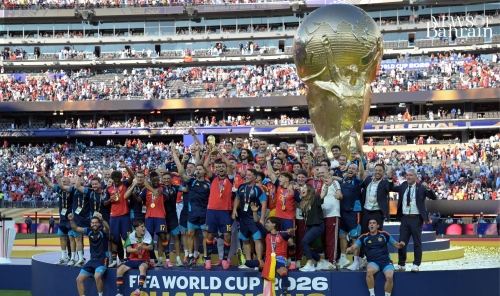
Torres the hero as Spain dethrone Argentina in extra-time classic
Spain's patience and discipline proved the difference as Ferran Torres's clinical late finish secured a 1–0 victory and a second World Cup crown
It took 106 minutes, a red card, and a substitute's composed finish, but Spain are world champions once more. Ferran Torres, introduced from the bench, settled one of the most disciplined and nerve-shredding World Cup finals in recent memory with a crisp, low strike moments into the second period of extra-time, ending Argentina's four-year reign as champions.
For long stretches at the MetLife Stadium in New Jersey, it seemed as though this final would be defined not by goals, but by what Emiliano Martínez denied. The Argentina goalkeeper was imperious throughout, repelling wave after wave of Spanish pressure with a series of outstanding saves that kept his side level long after their tactical plan had been reduced to sheer resilience.
Spain, who conceded just one goal across seven matches en route to the final, were the dominant force from the first whistle. Luis de la Fuente's side moved the ball with the tempo and precision that has made them the most feared possession team at this tournament, suffocating their opponents with quick passing triangles and relentless movement off the ball.
Yet for all their control, Spain could not find a way through until fortune finally turned against Argentina's rearguard. In the dying seconds of normal time, midfielder Enzo Fernández received a second yellow card for a reckless challenge on Pau Cubarsí, reducing the defending champions to ten men and shifting the balance of the contest irrevocably.
Extra-time followed a familiar pattern: Spain in possession, Argentina compact and disciplined behind the ball, Martínez alert to every danger. The breakthrough, when it arrived, was well worth the wait. A clever back-heel from Nico Williams on the left flank played Torres into space inside the penalty area, and the Valencia forward did the rest, drilling the ball low past Martínez to send the Spanish bench erupting onto the pitch.
For Lionel Messi, the moment was bittersweet. The Argentina captain — playing what may well be his final World Cup match — had carried his side through the knockout rounds with characteristic tenacity, orchestrating a stunning comeback against Egypt in the quarter-finals and a recovery from a goal down to beat England in the semi-finals. But Spain were simply too well-organised, too relentless, and, in the end, too good.
Spain are world champions for the third time in their history, and for a nation that has spent much of this decade rebuilding after the golden generation of 2008–2012, this triumph feels like the arrival of something new, not the echo of something old.
Spain's system outlasts Argentina's spirit
How Luis de la Fuente's unwavering tactical plan dismantled the defending champions and secured the greatest prize in football
When the dust settles on the 2026 World Cup, it will be remembered as the tournament where football's most beautiful philosophy was restored to the top of the world. Spain arrived in North America without the marquee names that defined their era of dominance, but they left as champions, proof that a collective built on trust, technique, and tactical clarity can still conquer the game's highest stage.
Luis de la Fuente deployed a system in New Jersey that was as familiar as it was effective: high pressing out of possession, rapid transitions in midfield, and wide forwards who could both combine intricately and run at defenders in space. The structure was almost identical to the one that won Euro 2024, but here it was refined, hardened, and made more resilient against the very best opposition.
In seven matches at this tournament, Spain conceded a single goal. No team in the final bracket matched their passing accuracy, their distance covered per match, or their expected-goals tally. They were, by almost every available metric, the best team at the World Cup — and the final bore that out.
Argentina entered the match with a contrasting brief: defend deep, frustrate, and trust in Martínez and Messi to produce the moments that lesser sides cannot conjure. It very nearly worked. Martínez was extraordinary, making at least five saves that would have been categorised as goals against any other goalkeeper. And for ninety minutes, Messi drifted between the lines, searching for the pocket of space that might unlock Spain's carefully maintained defensive shape.
But there is a limit to what even the greatest player in history can produce when his side has been reduced to ten men and is being pressed relentlessly by opponents who know exactly what they are doing. Once Fernández departed in stoppage time, Argentina's plan collapsed. The space in behind that they had carefully protected vanished, and Spain, patient and precise, found their moment.
The goal, when it arrived, was a fine example of what this Spain team does best: combination play through tight spaces, intelligent movement off the ball, and a finisher cool enough to take the moment when it presented itself. Torres did not hesitate. Neither, ultimately, did Spain. They were the best team in the world long before Torres tucked that ball into the corner. The World Cup simply confirmed it.
Mbappé rewrites history with record-breaking Golden Boot
France's captain finishes as the leading scorer for the second successive World Cup and becomes the highest scorer in the history of the tournament
In a tournament that will be remembered for Spain's triumph, the outstanding individual story of the 2026 World Cup belongs to Kylian Mbappé. The France captain scored ten goals across the competition — including two in Saturday's third-place play-off defeat to England — to claim the Golden Boot for the second consecutive World Cup and become the highest scorer in the history of the tournament.
With his ten goals in North America added to the twelve he accumulated across the 2018 and 2022 tournaments, Mbappé now stands alone at the top of the all-time scoring chart with 22 World Cup goals. He moves one ahead of Lionel Messi, who could not add to his tally of eight goals in Sunday's final and finishes this edition in second place on the top scorers list.
The record provides only partial consolation for the Real Madrid forward. France, who reached the semi-finals before being eliminated by England in a dramatic penalty shootout, were aiming for a third world title, and Mbappé — playing what may still be his peak years — was at times the best player in the tournament. He is now the first man to win back-to-back Golden Boots at a World Cup since the individual prize was formalised, an achievement that underlines a consistency of output almost without precedent in the history of the game.
England midfielder Jude Bellingham and Norway striker Erling Haaland each finished with seven goals, joint third on the list. Both were central to their sides' runs to the semi-finals and final respectively, with England ultimately lifting the third-place trophy after beating France 6–4 in a remarkable play-off.
Mbappé, speaking after the play-off, acknowledged the weight of the record but made clear where his priorities lie. He noted that he would have gladly traded the distinction of being the all-time top scorer for the chance to play in Sunday's final — a sentiment that captures both his fierce competitiveness and the bittersweet nature of individual honours won without the ultimate team prize.
At 27, Mbappé has time to add to his tally in 2030. Whether he does will depend not only on his own continued brilliance but on France's ability to rebuild around him once more. For now, though, the records speak for themselves: no man in World Cup history has scored more, and no player of his generation has performed more consistently on football's grandest stage.
Related Posts