

New Building Bill Sets Time Curbs
Building Bill Brings BD50,000 Fines and Time Curbs
TDT | Manama
Email: mail@newsofbahrain.com
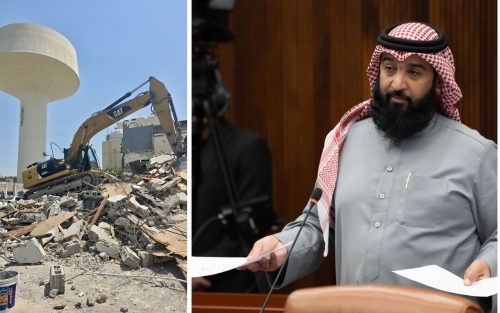
MPs will vote on a government-drafted bill giving the minister power to bar construction at set times and authorities power to fine offenders up to BD50,000 or order unlawful work torn down when Parliament returns for the next legislative convening period.
The 54-article Building Regulation Law, obtained by The Daily Tribune, would replace Bahrain’s 1977 building law and govern permits, site checks, construction standards, completion certificates, unsafe buildings and enforcement.
Building without a licence, breaking its terms, using false information to obtain one or obstructing inspectors could also bring jail and a fine of BD1,000 to BD20,000, or either punishment. Companies could face up to twice the maximum fine.
Parliament’s Public Utilities and Environment Committee has recommended that MPs approve the bill in principle, with amendments.
It also rejected a separate Shura Council proposal on construction hours and added its substance to Article 52 of the government bill because the 1977 law would be repealed.
Under the committee’s wording, the minister would choose the days and times when building work is barred and spell out cases in which it can still go ahead.
The Shura proposal had focused on construction, demolition and excavation in residential areas and would have left each municipality to decide local restrictions. The revised clause gives that power to the minister and is not confined to residential districts.
The bill would cover all building projects in Bahrain, including temporary structures. It aims to speed up permit handling, raise building standards and encourage investment.
Building work would normally need a licence, though some small or temporary jobs could be exempt under the executive regulations.
Applications could be filed online and would need proof of ownership or another right to build, approved engineering drawings and any other required papers.
The relevant municipality would handle approvals needed from other state bodies.
Private engineering offices could check drawings or inspect properties, subject to rules on independence and conflicts of interest.
Anyone refused a licence would have to be given written reasons. They could first challenge the decision before the authority and then take the case to court.
The committee also wants to remove fixed periods in the draft under which a licence could be cancelled if work had not begun within a year or had stopped for six months. Those periods would instead be written into the executive regulations.
Most building work would have to be carried out under an engineering office. Large projects could be required to keep one or more qualified engineers on site.
Work would have to follow approved drawings. Major structural changes would need further approval.
Fences could be made compulsory around some worksites, while certain buildings would have to provide access and facilities for people with disabilities.
Engineering tests could be ordered before, during or after construction to check structural strength, safety, health or environmental rules.
A building under construction could not normally be occupied before receiving a completion certificate. Electricity, water and other public services could not be connected before that certificate was issued.
Engineering offices and contractors would also carry direct legal duties.
The supervising office and contractor would be jointly responsible for safe construction, structural work and keeping the building within approved plot lines, setbacks and height limits.
The bill would also give municipalities powers over buildings already standing.
They could inspect properties and, with court approval where needed, order repairs, strengthening or partial or total demolition to protect lives and property. The same powers could apply to abandoned buildings.
If an owner failed to carry out required work, the authority could do it and recover the cost.
Low-income owners could be exempted from some or all of those costs or allowed to pay in instalments.
Suspected breaches could be investigated without waiting for a complaint. An inquiry could begin on the authority’s own initiative, after a complaint or at the ministry’s request.
Any suspected crime found during that inquiry would have to be sent to the Public Prosecution.
Article 41 contains the main enforcement powers.
Once a breach was proved, the authority could stop the job, order work to be corrected, demand demolition where unlawful construction was too serious to fix, cancel the licence or impose an administrative fine of BD500 to BD50,000.
The Municipalities Affairs and Agriculture Ministry gave examples of breaches that could draw such fines: building on state land, crossing property boundaries, building in prohibited areas, encroaching on road reserves and work that threatens structural safety, lives or property.
Related Posts