

Act Before Crises Escalate into Open Conflicts
UN Charter provides mechanisms for mediation, de-escalation and diplomatic solutions, says envoy
Bahrain reaffirmed its steadfast commitment to the peaceful settlement of disputes, warning that the growing number of global flashpoints and escalating tensions require the international community to act before conflicts develop into open confrontations.
The Kingdom stressed that the United Nations Charter, particularly Articles 33 and 34, provides essential tools for early intervention, enabling the UN Security Council to assess escalation risks, support mediation efforts, reduce tensions and create conditions for diplomatic solutions.
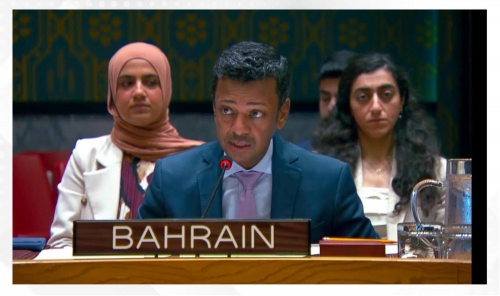
The remarks were delivered by Bahrain’s Permanent Representative to the United Nations in New York, Ambassador Jamal Fares Alrowaiei, during a Security Council session on strengthening the peaceful settlement of disputes.
The session was attended by UN Secretary-General António Guterres and chaired by the Democratic Republic of the Congo, represented by Foreign Minister Thérèse Kayikwamba Wagner.
Addressing current regional developments, Ambassador Alrowaiei strongly condemned Iran’s attacks on Gulf Cooperation Council (GCC) countries and Jordan, as well as the closure of the Strait of Hormuz, describing such actions as threats to regional security and international maritime routes.
He highlighted Iran’s failure to meet its international obligations, including commitments made under the “Islamabad Memorandum of Understanding”, and its non-compliance with UN Security Council Resolution 2817, which 136 countries co-sponsored.
The ambassador also noted Iran’s continued failure to adhere to several UN resolutions calling on it to adopt responsible conduct that contributes to regional security and refrain from supporting proxy groups.
He pointed out that some countries targeted by Iran had previously played constructive roles in mediating between Tehran and the international community, but those efforts did not prevent them from becoming targets.
The envoy also referred to Security Council Resolution 2788, unanimously adopted in 2025 following an initiative by Pakistan, stressing the need for the effective and consistent use of peaceful dispute settlement mechanisms and a shift from reaffirming principles to implementing them in practice.
He called for the full implementation of Resolution 2788 through greater use of the tools available under Chapter VI of the UN Charter, encouraging parties to pursue dialogue, mediation and confidence-building measures.
Ambassador Alrowaiei further stressed the importance of strengthening cooperation between the United Nations and regional organisations to achieve peaceful and acceptable solutions.
He added that diplomacy must be given the necessary time and space to succeed, while stressing that calls for dialogue cannot replace the obligation to respect international law.
Ambassador Alrowaiei said strengthening peaceful dispute resolution requires political will, early action and more effective use of the UN Charter’s mechanisms to enable the Security Council to help reduce tensions, support diplomatic solutions and safeguard international peace and security.
Related Posts