

English legal papers rule to save firms translating thousands of files
TDT | Manama
Email: mail@newsofbahrain.com
Bahrain’s move to allow a wider range of legal papers to be notarised in English will cut translation bills, reduce delays and help courts deal with commercial disputes faster, a senior civil court judge has said.
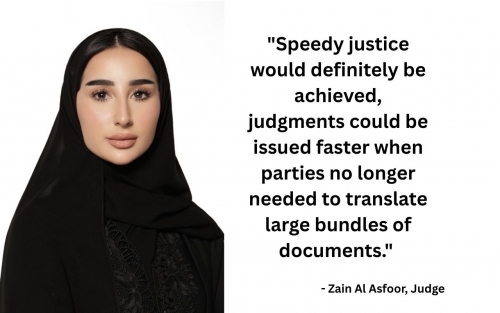
Judge Zain Al Asfoor, of the High Civil Court, said the change would ‘eliminate the need for costly certified translation’ of commercial documents, particularly in cases involving large volumes of contracts, records and supporting papers.
Her remarks came after Justice, Islamic Affairs and Waqf Minister Nawaf bin Mohammed Al Maawda issued Decision No. 47 of 2026, allowing notarial papers, attested signatures and dated private documents to be completed in English when the parties ask for it, unless another law requires Arabic.
Judge Al Asfoor said some commercial cases involved ‘thousands and thousands of documents’ that would otherwise have to be translated into Arabic before they could be used in proceedings.
The use of English, she said, would ‘reduce delays’ because translation often takes considerable time. It would also ‘minimise the risk of translation errors or discrepancies that may affect legal outcomes’, since some words can carry different meanings once rendered into another language.
She added that lower translation costs would ‘lower the overall litigation costs for the parties and businesses’, while helping courts move cases more quickly.
Judge Al Asfoor said the move was in line with Bahrain’s judicial vision of faster justice, while still protecting fairness, allowing parties time to exchange memoranda and defences, and ensuring judgments remain of high quality.
Decision No. 47 of 2026 applies to documents that fall within Decree Law No. 14 of 1971 on notarisation. That law regulates the work of the notary office, including the notarisation of documents required by law or requested by parties, attesting signatures, proving the date of private papers and keeping notarial records.
The new order replaces Decision No. 78 of 2017, which dealt with documents that could be notarised in a foreign language, namely English. The 2017 decision had been amended in 2019.
Under the new decision, English may be used only where the document falls within the scope of the notarisation law and the parties choose that language. The exception remains any case in which another law requires notarisation in Arabic.
Related Posts