

Can Glasgow Keep Its Edge in Europe’s Space Race?
Glasgow is transforming a historic industrial strength into a modern space success story, emerging as one of Europe’s leading centres for small-satellite manufacturing.
The city’s rise began in 2005, when space engineer Craig Clark returned to Glasgow and founded Clyde Space, a company focused on developing small and relatively low-cost satellites. The business helped establish the foundations of a commercial space industry in the city.
Glasgow is particularly known for producing CubeSats — compact spacecraft built around standardised units measuring about 10cm by 10cm by 10cm. Their small size allows companies to develop and launch them more quickly and at lower cost than traditional large satellites.
From Shipbuilding to Satellites
Glasgow’s space industry has developed a striking connection with the city’s industrial past.
The River Clyde was once synonymous with shipbuilding and engineering. Today, some of those engineering traditions have found a new home in the design and manufacture of spacecraft.
The Scottish Government said: Glasgow builds more small satellites than anywhere else in Europe, while Scotland has developed expertise across satellite manufacturing, launch and satellite-data analysis.
The sector is supported by a network of companies and research institutions, including AAC Clyde Space, Spire Global and Alba Orbital, as well as the University of Strathclyde.
Universities Help Drive Growth
The partnership between industry and academia has been central to Glasgow’s success.
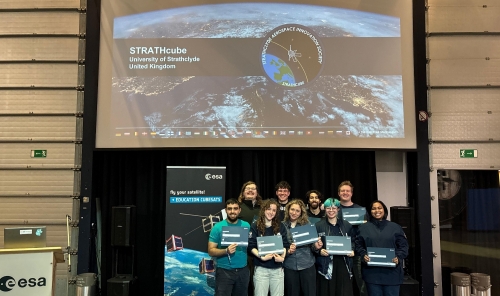
The University of Strathclyde has worked closely with the space industry on satellite research, engineering, manufacturing and data applications. The university was also involved in the development of Scotland’s small-satellite sector and continues to support research and training.
More recently, Strathclyde has taken a leading role in Project PRISM, part of a potential £160 million Glasgow City Region Investment Zone programme. The £100 million space initiative aims to strengthen research, manufacturing and the development of space technologies from early-stage concepts through to launch.
Europe Raises the Stakes
The challenge for Glasgow is that it is no longer competing in an emerging industry with little competition.
European governments are increasingly investing in satellites and space infrastructure as countries seek greater technological and strategic independence.
The European Space Agency has warned that Europe's growing number of national satellite programmes need better coordination to avoid duplication and fragmentation. At the same time, major European projects such as the EU’s IRIS² communications constellation are bringing billions of euros into the region's space sector.
The European push creates opportunities for Glasgow but also raises the pressure on the city to maintain its position.
Can Glasgow Stay Ahead?
Glasgow already has several advantages: an established manufacturing base, experienced companies, specialist engineers and strong links between industry and universities.
The city also benefits from Scotland’s wider space ecosystem, including research facilities and developing launch infrastructure. Glasgow’s regional investment plans identify space as one of the sectors capable of driving future economic growth.
But maintaining that advantage could require continued investment.
The question is whether Glasgow can attract enough funding, companies and skilled workers to expand its space industry while competing with increasingly ambitious satellite programmes elsewhere in Europe.
For a city once defined by ships built on the Clyde, the next chapter may increasingly be written in orbit.
Related Posts