


A New Way to Explore the Universe
For centuries, astronomers have relied mainly on light to study the universe. But scientists now have another way of looking into the cosmos — by tracking tiny particles known as neutrinos.
That new approach has been central to the work of Belgian-American physicist Francis Halzen, who was awarded the 2026 Nobel Prize in Physics on Tuesday for his decisive contributions to the IceCube Neutrino Observatory and the discovery of high-energy neutrinos of astrophysical origin.
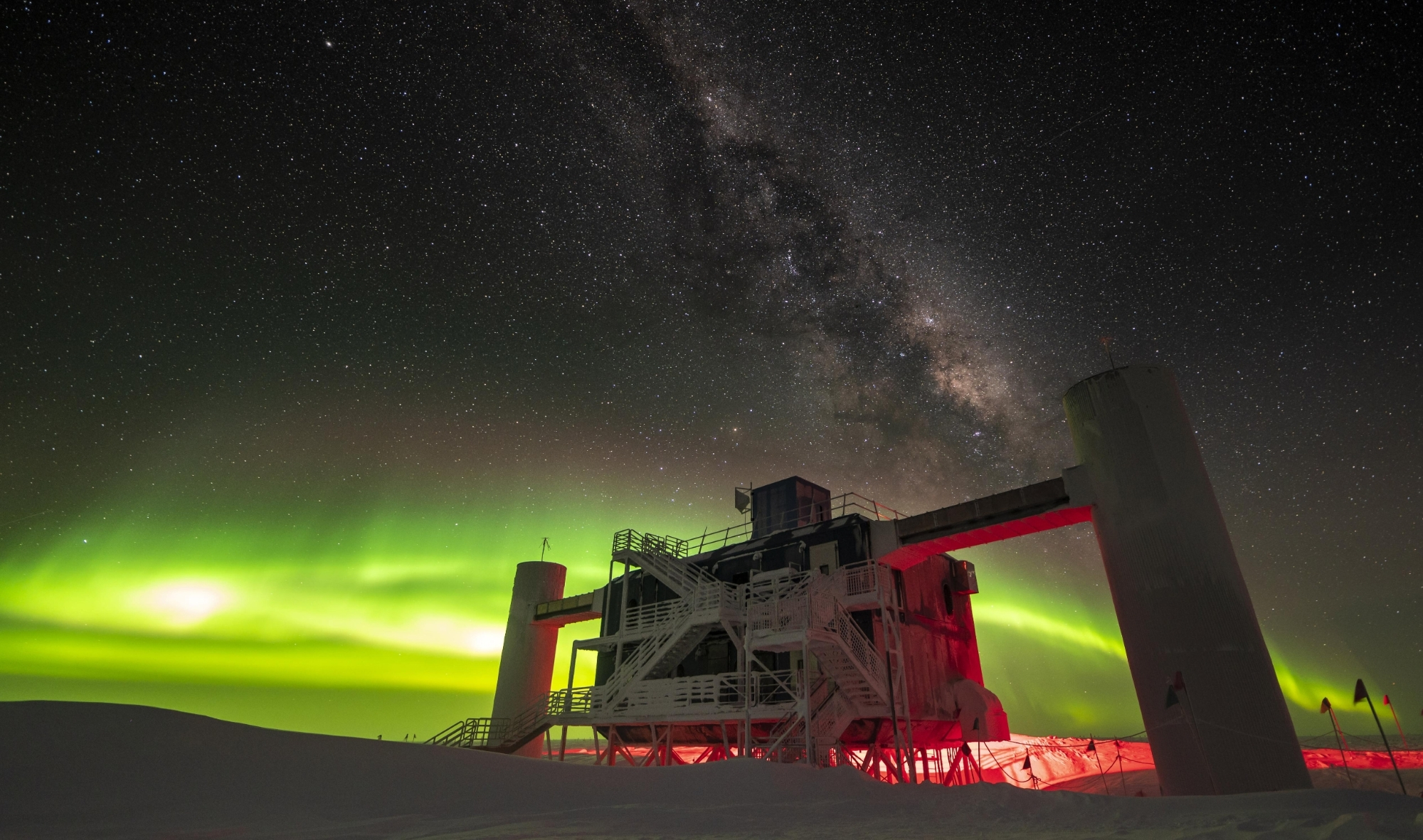
IceCube, located at the South Pole, is unlike a conventional telescope. Instead of looking through a lens at distant stars and galaxies, it uses about one cubic kilometre of Antarctic ice as a giant particle detector.
Thousands of light sensors are embedded deep beneath the ice. When a high-energy neutrino occasionally collides with matter in the ice, the interaction produces a tiny flash of light. The sensors capture that signal, allowing scientists to reconstruct the neutrino's path and investigate where it came from.
Neutrinos are sometimes described as “ghost particles” because they interact so weakly with matter. Enormous numbers pass through Earth and the human body without being detected.
But that unusual ability is precisely what makes them valuable to astronomers.
Unlike light, neutrinos can travel across enormous distances without being easily absorbed or deflected. They can therefore carry information directly from some of the most energetic and violent environments in the universe.
Scientists are particularly interested in neutrinos produced by extreme cosmic events, including exploding stars and environments associated with black holes. Studying these particles can provide clues about how such powerful events produce and accelerate cosmic particles.
The Nobel Committee said Halzen's vision and scientific leadership were fundamental to IceCube, describing the observatory as a way to capture neutrinos from energy-rich processes in the distant universe.
Halzen first proposed using the South Pole's enormous volume of ice to detect neutrinos in 1988. The idea eventually became IceCube, which was completed in 2011.
The project transformed a natural block of Antarctic ice into one of the world's most unusual scientific instruments. Researchers have since used it to detect high-energy neutrinos originating outside our Solar System, opening what scientists describe as a new field of neutrino astronomy.
The significance goes beyond detecting another type of particle. Neutrinos provide scientists with a different messenger from the cosmos.
Traditional telescopes can show scientists what distant objects look like through light. Neutrino detectors can provide information about the physical processes taking place inside or around those objects.
That means astronomers can combine information from light, neutrinos, gravitational waves and cosmic rays to build a more complete picture of extreme events in the universe.
Halzen said he was surprised that his original idea worked as well as it did. The Nobel recognition now places that decades-old vision at the centre of a new approach to understanding the cosmos.
The next generation of neutrino observatories could push that work even further, allowing scientists to detect more particles and identify more distant sources.
For astronomy, the achievement represents a fundamental shift: scientists are no longer limited to observing the universe through light. They can also listen to the universe through the particles that travel across it.
Related Posts