

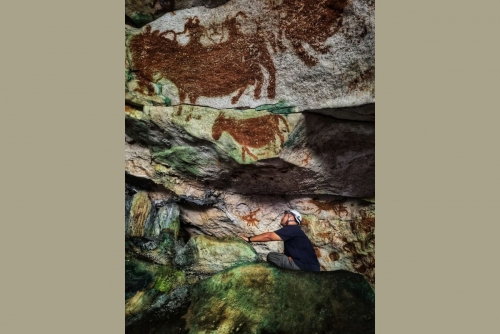
Ancient Cave Art Discovery Rewrites Human Art Timeline
Email: online@newsofbahrain.com
Sulawesi: Scientists have identified what may be the oldest known cave art in the world, a stencilled hand outline with claw-like fingertips, discovered in a limestone cavern on Muna Island, Indonesia. Dated to at least 67,800 years ago, this prehistoric painting pushes back the timeline for symbolic artistic expression by early humans and offers fresh insight into our ancestors’ cognitive development.
Archaeologists from Indonesia and Australia made the discovery in the Liang Metanduno cave, a site long known for rock art. The artwork a hand stencil created by placing a hand against the cave wall and spraying red pigment around it was found beneath thick layers of mineral deposits that formed over tens of thousands of years. By analysing these minerals using uranium-series dating, researchers established a reliable minimum age for the painting, making it older than previous record-holders in Europe.
What sets this hand print apart is its distinctive finger shape. The fingertips appear deliberately narrowed and pointed, almost like claws a stylised form not typically found in ancient art and possibly reflecting complex symbolic intention. Researchers say this detail suggests that the artist was not simply making a mark, but intentionally transforming the human hand image, hinting at advanced cognitive and cultural capabilities.
Until now, the oldest widely accepted cave art included hand stencils in Spain attributed to Neanderthals and animal paintings in nearby regions of Indonesia dated to younger ages. The newly dated Indonesian hand stencil precedes those examples by more than a millennium, prompting scholars to reconsider where and how early symbolic behaviours emerged in human history.
“This discovery underscores that early humans were developing artistic and symbolic traditions far earlier and in more diverse places than previously understood,” said a co-author of the study published in Nature. The findings suggest that creative expression was not unique to Europe’s Ice Age populations but was taking place deep in Southeast Asia long before the arrival of Homo sapiens in Australia.
The discovery also has implications for how researchers understand ancient human migration patterns. Many of the people responsible for these early artworks were part of a population that dispersed through Southeast Asia and may have continued on to the ancient landmass of Sahul a prehistoric land bridge connecting present-day Australia and New Guinea. This supports evidence for early movement of modern humans out of Africa and across island chains long before previously thought.
Archaeologists emphasise that this finding is just one piece in a growing picture of ancient creativity. Other hand stencils and rock paintings dating from later periods indicate that symbolic art became a widespread and persistent practice in the region, reflecting intricate cultural traditions over tens of thousands of years.
Researchers say further exploration and dating of additional sites could reveal even older examples of symbolic art and help clarify the timeline of human cognitive evolution.
Picture credit:AFP
Related Posts