

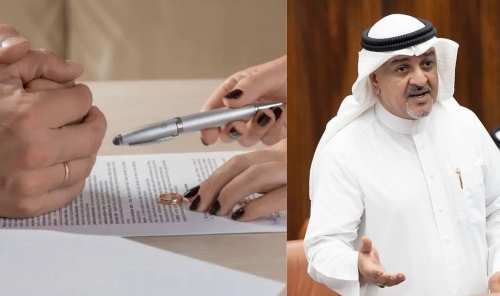
Bahrain records five divorces a day, straining families and state support, says MP
Five divorces a day and more than 20,000 cases in a decade have been recorded in Bahrain, MP Jalal Kadhem told Parliament, citing Justice Ministry data and warning of pressure on families, children and state support. During a debate on the ministry’s reply to his parliamentary question, he said Sharia courts had registered 5,284 divorce cases among Bahrainis over the past three years.
According to the reply, this works out to five divorce cases a day, roughly one every five hours, against 12 marriages a day. MP Kadhem said this showed that “almost half of cases end in divorce, which poses a direct threat to the cohesion of society”.
Cases
He added that 94 per cent of the divorce cases recorded during the period of the question involved long-standing marriages with children, rather than recent marriages as some might assume. The lawmaker said this added to the social and psychological strain on sons and daughters caught up in marital disputes. He said Bahrain had recorded more than 20,000 divorce cases in the past 10 years.
Support
MP Kadhem linked this to government support programmes, saying the state spends about BD66 million each year on housing, cost-of-living and social security allowances for divorced women. A large share of current housing applications, he said, comes from divorced women or families that have separated because of divorce, which has added to pressure on the housing file. On family reconciliation, Kadhem said settlement rates at the family reconciliation office had fallen while the number of referred cases had grown.Some disputes were resolved, but most ended without agreement.
Worrying sign
He described this as a worrying sign in a country of about 700,000 people, and said it showed that family disputes were growing more tangled and that it was becoming harder to reach middle-ground solutions between spouses. The legislator listed several factors he believes are linked to divorce, including weak communication within families, constant use of social media, economic pressure and higher living costs. He also mentioned poor understanding of marriage, the impact of some media content, interference from relatives and cases of domestic violence.
Effects
The effects cited included poorer school performance and mental health among children, weaker community ties, higher costs for the state and lower productivity among adults involved in family disputes. Kadhem called for steps to address the issue. He proposed a joint committee bringing together the Supreme Council for Islamic Affairs, the Supreme Council for Women, the Ministry of Social Development and the Interior Ministry to draw up a national plan for handling family cases. He also urged the creation of advisory centres in every governorate, stronger pre-marriage preparation through compulsory courses and a larger role for religious and community bodies.
He further called for stricter control of media content which, in his words, ‘breaks up families and encourages separation’. The MP also criticised the ministry’s reply to his question on the total number of cases before the Sharia courts. He said the figures provided covered only marriage and divorce, although he had asked for the total caseload, including maintenance, khul‘, custody, inheritance, waqf-related disputes, missing persons and other Sharia proofs. He said the data submitted did not answer the first part of his question to the minister.
Related Posts