

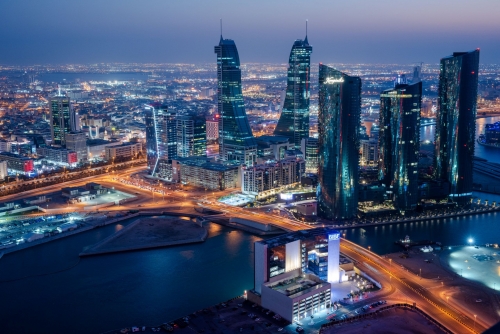
Sustained progress, bright future ahead
TDT | Manama
Email: mail@newsofbahrain.com
Bahrain’s economy grew by 2.7 per cent in real terms in the first quarter of 2025, lifted by a 2.2 per cent rise in non-oil activity, the Bahrain Chamber of Commerce and Industry said in its report “Overview of the Local Economy Q1 - 2025”.
Accommodation and food services led with 10.3 per cent growth.
Financial and insurance activities rose 7.5 per cent, while construction was up 5.4 per cent.
Financial and insurance remained the largest single share of real GDP at 17.4 per cent.
Trade with Gulf partners eased. Bahrain–GCC exchange came in at $2.14 billion, down 10 per cent from $2.38 billion a year earlier.
Domestic payments
At the same time, domestic payments moved further online: Fawri+ transactions were up 11 per cent and point-of-sale transactions rose 14 per cent. Bahrain ranked second in the Arab world in the 2025 Quality of Life Index.
The report set the global backdrop with the IMF’s October 2024 outlook. Investment in advanced economies is forecast to reach 22.5 per cent by 2026.
In the European Union, general government revenue is projected at 45.7 per cent for 2024, 2025 and 2026.
Top export market
Saudi Arabia was Bahrain’s top export market in the quarter, taking $727 million.
The main item was unwrought aluminium alloys worth $113 million, 16 per cent of sales to the kingdom.
The United Arab Emirates followed with $479 million, led by agglomerated iron ores and concentrates at $85 million (18 per cent).
Third
The United States ranked third on $262 million, with unwrought aluminium alloys at $124 million (47 per cent).
Qatar placed fourth with $179 million, of which agglomerated iron ores and concentrates made up $143 million (80 per cent).
The Netherlands was fifth on $129 million, headed by unwrought aluminium alloys at $61 million (47 per cent).
Total trade
Within the GCC, total trade stood at $2.14 billion. Exchange with Qatar rose 164 per cent year on year, from $73 million to $192 million.
Saudi Arabia recorded the largest bilateral flow with Bahrain at $944 million, followed by the UAE at $795 million.
On imports, Australia ranked first with $595 million.
Related Posts