

WHO Says Pakistan Has ‘Historic Opportunity’ to End Polio Transmission
Global health body urges intensified efforts as country records three cases in 2026
The World Health Organization (WHO) has said Pakistan is at a critical stage in its fight against polio, with a “historic opportunity” to interrupt virus transmission if current eradication efforts are strengthened over the next six to 12 months.
WHO Regional Director for the Eastern Mediterranean, Dr Hanan Balkhy, made the remarks during a recent visit to Pakistan with the Polio Oversight Board (POB), reaffirming the organisation’s support for the country’s campaign to eliminate paralytic polio.
Dr Balkhy praised Pakistan’s “strong leadership” and government-wide commitment to fighting the disease, saying the goal of ending polio in Pakistan and across the region is now within reach.
“Discussions with national authorities and experts, together with the available evidence, show that Pakistan has a genuine opportunity to interrupt poliovirus transmission,” Dr Balkhy said.
“We have the tools: proven vaccines, the best available science, and the extraordinary commitment of hundreds of thousands of frontline health workers, backed by steadfast government leadership. But this opportunity will only be realised if we intensify our efforts over the next 6 to 12 months – a period that will be critical.”
Pakistan has achieved a 99.8 per cent reduction in polio cases over the past three decades. The country has reported three cases so far in 2026, with transmission now largely limited to southern Khyber Pakhtunkhwa.
Dr Balkhy warned that failing to maintain momentum would carry a far greater cost than the investment required to complete the eradication effort.
“The goal is within reach and the cost of inaction – for Pakistan, the region and the world – would far outweigh the investment needed to finish the job,” she said.
High-level delegation meets Pakistani leadership
Dr Balkhy was part of a high-level POB delegation led by Mike McGovern, Chair of the Polio Oversight Board and Rotary International PolioPlus Committee.
The delegation included senior representatives from global health organisations, including UNICEF Asia Pacific Regional Director Sanjay Wijesekera, King Salman Humanitarian Aid and Relief Centre (KSrelief) Senior Advisor Dr Ziad Memish, Gavi CEO Dr Sania Nishtar, Gates Foundation Global Development President Dr Chris Elias, and US Centers for Disease Control and Prevention (CDC) Polio Team Lead Dr Omotayo Bolu.
During the visit, the delegation held meetings with Pakistan Prime Minister Shehbaz Sharif, Federal Health Minister Syed Mustafa Kamal, Prime Minister’s Focal Person for Polio Eradication Senator Ayesha Raza Farooq, Deputy Prime Minister and Foreign Affairs Minister Ishaq Dar, and Pakistan Army Engineer-in-Chief Lieutenant General Kashif Nazir.
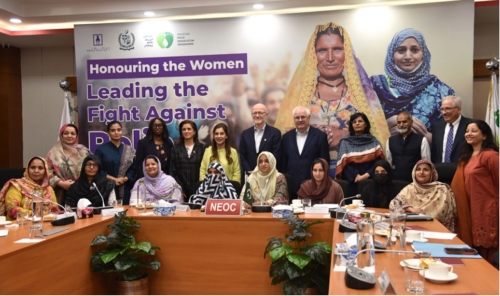
The team also met female frontline health workers who are among more than 400,000 polio workers deployed across Pakistan. Around 60 per cent of these workers are women, and they are mobilised several times each year with support from WHO and international partners.
Dr Balkhy commended Prime Minister Sharif and the Pakistani government for their commitment to protecting children from polio.
“Ending polio will require sustained commitment at every level of government, together with the continued dedication of frontline health workers, communities and partners,” she said.
Related Posts