

Controlled' quakes triggered under Swiss Alps
Email: online@newsofbahrain.com
Bedretto: In a landmark geological study, researchers at the BedrettoLab in southern Switzerland have successfully triggered approximately 8,000 "controlled" earthquakes deep within the Alpine rock. Led by the Federal Institute of Technology in Zurich (ETH Zurich), the experiment represents a significant leap in seismic research, aiming to understand the mechanics of fault movement to mitigate the risks associated with human underground activity.
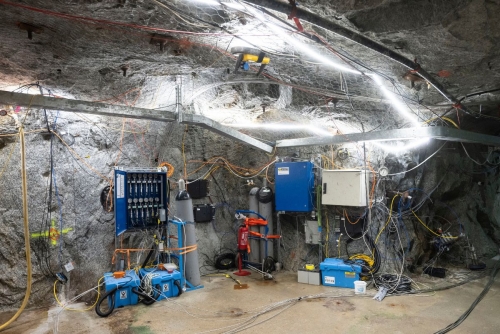
By utilizing a specialized "earthquake machine" located 1.5 kilometers beneath the surface, scientists are now able to observe seismic events at a scale and depth never before attempted.
The project, titled Fault Activation and Earthquake Rupture (FEAR-2), involved a sophisticated four-day operation in late April where researchers injected 750 cubic metres of water into boreholes drilled into an existing fault line.
The primary objective was to induce a magnitude-1 earthquake to observe how pressure facilitates movement without creating new faults. While the highest recorded magnitude reached -0.14 just below the initial target the mission was deemed a success due to the unprecedented volume of data collected on how faults respond to high-pressure injections.
The practical motivations for this research are rooted in the growing necessity for safe underground exploration and energy extraction. Human-induced seismicity is a rising concern in industries such as geothermal energy, fracking wastewater disposal, and deep excavation.
By mastering the ability to produce quakes of a specific, controlled size, scientists hope to develop protocols that prevent the accidental triggering of dangerous events, such as the 5.4-magnitude Pohang earthquake in South Korea in 2017.
Looking ahead, the team at ETH Zurich plans to leverage these findings to refine their injection parameters for a subsequent attempt in June 2026. The ultimate goal is to move toward a "safe" mastery of the underground, ensuring that as global energy and infrastructure needs expand further into the Earth's crust, they do so with a sophisticated understanding of how to manage and prevent seismic instability.
Related Posts