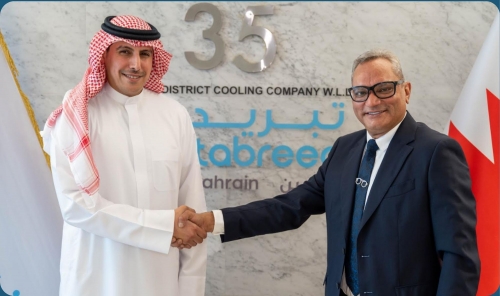
Tabreed Bahrain has announced the appointment of Arabian International Company WLL as the Engineering, Procurement and Construction (EPC) contractor for the expansion of its chilled water network in the northern seafront area of Manama.
The project is part of the company’s medium-term strategy to meet rising cooling demand across key urban developments. Once completed, the expansion will add 12,000 Refrigeration Tonnes (RT) to Tabreed Bahrain’s connected capacity, with operations expected to begin in summer 2027.
The expansion aims to improve the efficiency and reliability of cooling supply while supporting broader energy optimisation goals. By increasing the use of district cooling, the project will help ease pressure on Bahrain’s electricity transmission and distribution systems, while promoting more efficient energy consumption and reducing carbon emissions.
The investment reflects Tabreed Bahrain’s ongoing commitment to strengthening its presence in the Kingdom and advancing sustainable cooling solutions aligned with national net-zero targets.
Ali AlRumaihi, Country Manager of Tabreed Bahrain, said the project highlights the company’s long-term commitment to supporting Bahrain’s urban growth through reliable and energy-efficient infrastructure, noting that district cooling plays a vital role in reducing electricity consumption and enhancing overall system efficiency.
Rajan Sharma, Managing Director of Arabian International, expressed appreciation for the appointment, stating that the company looks forward to delivering the project to high standards of quality, safety, and efficiency, drawing on its extensive experience in executing complex EPC projects in Bahrain.
Arabian International, a Bahrain-based engineering and contracting firm, has a strong track record in infrastructure and utility projects across both public and private sectors.
The project is expected to support sustainable urban development in Manama by providing a scalable and energy-efficient cooling solution aligned with evolving environmental and infrastructure priorities.