

Students showcase Bahrain’s new era of agricultural innovation
Ghadeer Al Kumaish
Hasan Barakat
TDT | Manama
Email: mail@newsofbahrain.com
The Student Agricultural Innovations Expo 2025 opened yesterday at Bahrain Polytechnic, attended by His Excellency Dr Mohammed bin Mubarak Juma, Minister of Education, and Eng. Wael bin Nasser Al Mubarak, Minister of Municipalities and Agriculture, together with the Secretary-General of the National Initiative for Agricultural Development and senior ministry officials
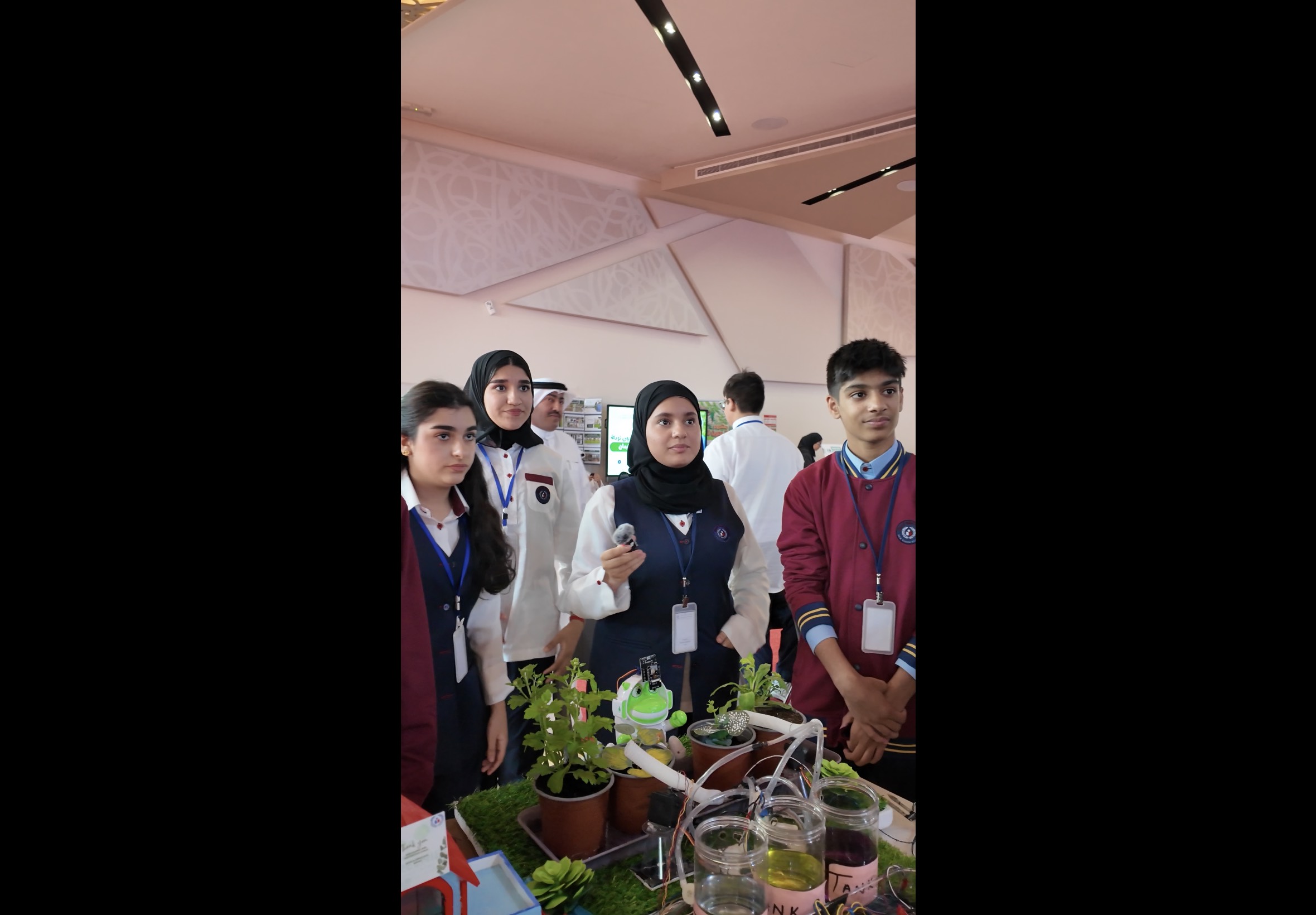
The ministers moved among the stands, tested prototypes and spoke directly with pupils from public and private schools who displayed practical, locally relevant projects.
AI-driven robot
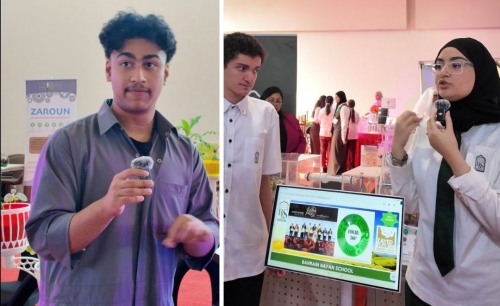
In an exclusive interview with The Daily Tribune, students from New Vision School presented AgroGuard, an AI-driven robot designed to monitor plant health.
The system uses a camera to analyse foliage for signs such as healthy leaves, yellowing from nutrient deficiency, fungal infections or dryness.
When a problem is detected, AgroGuard transmits signals through its software to trigger relevant treatments.
The team told the Daily Tribune the project targets Bahrain’s high temperatures and limited water resources and aims to reduce crop losses by enabling earlier diagnosis and intervention.
Sustainability lab
In another exclusive interview with The Daily Tribune, Bayan Bahrain School showcased Eco-Lab 360, a school-level sustainability lab that recycles grey water from the kitchen through multi-stage filtration for use in irrigating campus plants.
The students reported the system recycles roughly 3,000 litres a month.
They also demonstrated a soil-analysis app: users measure soil properties, enter the data and receive recommendations for the best crop, irrigation schedule and fertiliser regime.
The team plans to integrate robotic automation to simplify home and small-scale gardening.
Vertical hydroponic system
Al Hikma School’s Harvest Heights — also explained in an exclusive interview — is a vertical hydroponic system designed to maximise production in tight spaces.
The static tower supports 36 plants; solar panels charge lithium-gel batteries that run DC pumps to deliver water and organic nutrient solution evenly through pipe work and gravity feed.
The students emphasised the system’s suitability for Bahrain’s limited arable land and arid conditions, offering a compact model for urban and school gardens.
Sheikh Khalifa bin Salman Institute — Solar water generation Purifying and harvesting water In an exclusive conversation with The Daily Tribune, student Ahmed Gharib from the Sheikh Khalifa bin Salman Institute of Technology displayed a hybrid water-production prototype that purifies non-potable water using solar concentration to create steam, then condenses and collects the purified liquid.
The design also includes a method to extract moisture from air by creating a cold surface for condensation. The system relies on solar panels (including recycled units), a low-voltage heater, a cooling unit with a compressor and a stored-water tank. A support module using batteries and a generator provides backup power; the team said they incorporate AI for automated control and voice-assistant compatibility for user commands.
Practicality over novelty
Across the hall, a consistent theme emerged: the students built solutions tightly calibrated to Bahrain’s realities — heat, scarce water and limited farming space — and focused on practicality over novelty.
Ministers engaged with the teams, asking technical questions and encouraging further development and potential scaling.
The projects combined engineering, software and sustainability in ways that suggest a real pathway from classroom prototypes to community or commercial application.
sdfdsf
Related Posts