

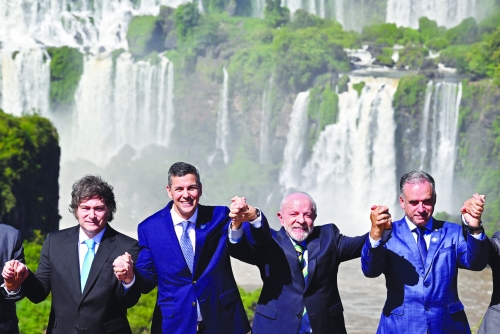
EU countries override France to greenlight Mercosur trade deal
AFP | Brussels
Email : editor@newsofbahrain.com
The EU gave a long-delayed go ahead yesterday to a huge trade deal with South American bloc Mercosur championed by business groups but loathed by many European farmers -- overriding opposition led by key power France.
A majority of the European Union’s 27 nations backed the pact following an ambassadors’ meeting in Brussels, paving the way for it to be signed in coming days in Paraguay.
More than 25 years in the making, supporters see the deal as crucial to boost exports, support the continent’s ailing economy and foster diplomatic ties at a time of global uncertainty.
European Commission chief Ursula von der Leyen called it “proof that Europe charts its own course and stands as a reliable partner” and said she looked forward to the signing -- which Argentina said was planned January 17.
German Chancellor Friedrich Merz likewise said the deal sent “an important signal of our strategic sovereignty and capacity to act,” a message echoed by Spain which said it would “forge shared prosperity” with Latin America.
On the Mercosur side, Brazil’s President Luiz Inacio Lula da Silva hailed “a historic day for multilateralism”.
But the European Commission, which negotiated the text, failed to win over all of the bloc’s member states.
Heavyweight France, where politicians across the divide are up in arms against a deal attacked as an assault on the country’s influential farming sector, led an ultimately unsuccessful push to sink it.
Ireland, Poland, Hungary and Austria also voted against the accord.
That was not enough to block it, however, after holdout Italy ultimately threw its weight behind the pact.
‘Economic clout’
The deal will create a vast market of more than 700 million people, making it one of the world’s largest free trade areas.
Part of a broader push to diversify trade in the face of US tariffs, it will bring the 27-nation EU closer together with Brazil, Paraguay, Argentina and Uruguay, removing import tariffs on more than 90 percent of products.
This will save EU businesses four billion euros ($4.6 billion) worth of duties per year and help exports of vehicles, machinery, wines and spirits to Latin America, according to the EU.
It will also help the bloc reduce its dependency on China for critical raw materials, said Agathe Demarais, of the European Council on Foreign Relations, a think tank.
“The conclusion of the EU-Mercosur trade deal is great news for Europe’s global geopolitical and economic clout,” she said.
Germany, Spain and other backers believe the deal will provide a welcome boost to their industries hampered by Chinese competition and tariffs in the United States.
But France and other critics opposed it over concerns that their farmers would be undercut by a flow of cheaper goods, including meat, sugar, rice, honey and soybean, from agricultural giant Brazil and its neighbours.
The deal still needs approval from the European Parliament and France has warned against any attempt to bring it into force before then -- vowing the fight is not over.
‘Pain’ vs ‘benefits’
Farmers in several European countries mounted a final show of anger against the text’s approval, marching in protest in Warsaw and blocking roads in France and Belgium.
“There is a lot of pain,” Judy Peeters, a representative for a Belgian young farmers group told AFP at a protest on a motorway south of Brussels. “There is a lot of anger.”
Over the past months, the commission has been at pains to reassure farmers and their backers that pros outweigh cons.
It stressed the accord is expected to boost EU agri-food exports to South America by 50 percent, in part by protecting more than 340 iconic European products -- from Greek feta to French champagne -- from local imitations.
It also laid out plans to set up a 6.3 billion euro crisis fund and safeguards allowing for the suspension of preferential tariffs on agricultural products in case of a damaging surge in imports.
The latter were tightened further at the last minute by member states lowering the threshold for action, in a late concession to Italy.
Angry farmers disrupted traffic in Milan with their tractors Friday, dumping barrels of straw and pouring milk on the ground in front of the regional council building.
But Italian Prime Minister Giorgia Meloni defended an agreement she hoped would “bring benefits in many areas” and “for everyone.”
Related Posts