

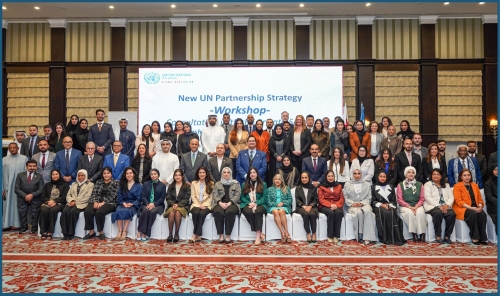
New UN Bahrain Partnership Model Aims to Accelerate SDG Progress
The United Nations in Bahrain held a two-day high-level consultation this week with representatives from the public and private sectors to advance a more coordinated, results-driven approach to partnerships under the UN Sustainable Development Cooperation Framework (UNSDCF) 2025–2029.
Facilitated by the Office of the United Nations Resident Coordinator in Bahrain, the workshops brought together UN officials, government representatives, and private-sector stakeholders, including members of the American Chamber of Commerce (AmCham) in Bahrain, the Bahrain Chamber of Commerce, and other business associations. The consultations marked a key step towards a new UN Bahrain–Public Sector–Private Sector Partnership Strategy for 2026–2029, aimed at strengthening alignment and collaboration on national development priorities.
UN Resident Coordinator Khaled El Mekwad emphasized the potential of structured partnerships to accelerate progress on shared priorities, particularly the Sustainable Development Goals (SDGs). He said the goal is “to make partnerships easier to implement, faster to launch, and better aligned with national development priorities,” highlighting that partnerships extend beyond funding to include technological expertise, innovation, data solutions, and co-financing models.
Hatem Abdelhamid Hatem, Chief of the Organisations Sector at Bahrain’s Ministry of Foreign Affairs, said the UNSDCF 2025–2029 provides “a strategic framework aligning UN support with Bahrain’s development priorities, including Bahrain Economic Vision 2030, while emphasizing results, innovation, and impact.” He stressed the importance of a structured “triangular model” bringing together the Government, the UN, and the Private Sector to translate priorities into concrete initiatives, investments, and scalable impact.
Participants explored effective pathways for UN–Private Sector partnerships, including a triangular UN–Government–Private Sector model to clarify roles, coordination mechanisms, and approval processes. They reviewed key findings from the new UN Bahrain partnership strategy, examined opportunities for SDG-aligned investment, and discussed practical engagement approaches to strengthen institutional coherence.
Priority areas for collaboration were identified, including manufacturing, food security, logistics and connectivity, digital transformation, FinTech, AI and ICT, clean and renewable energy, vocational education, healthcare, sustainable tourism and hospitality innovation, and gender and disability inclusion.
Related Posts