

Homer, Nolan, and the Words in Between
TDT | Manama
Email: mail@newsofbahrain.com
Much debate has been raging online about Christopher Nolan’s The Odyssey since its release in July 2026. Its casting, costumes, characters, sets and interpretation are all being argued over. While some laud the writer-director for his magnum opus, others lambast him for taking too much liberty with the epic.
“He’s taken his poetic licence too far,” say some angry viewers. But that is normal. If Nolan really wanted it to be perfect and true to its source, he should perhaps have made the movie not in English, but in authentic Ancient Greek, in the original dactylic hexameter—the way Homer wrote it. That is the mocking counter-voice.
Some debate its historical accuracy, even mapping out locations that the epic’s author might have been referring to. While Ithaca and Troy are real places, we cannot say the same of several other locations in The Odyssey.
We know that the story Homer wrote some 2,800 years ago, around 800 BCE, was about happenings roughly 400 years earlier, in the later part of the Bronze Age, around 1200 BCE. So, he may well have created some placenames.
According to The Conversation, a research, news and commentary website, Greek scholars and ancient geographers were already debating where exactly Odysseus had voyaged by 500 BCE. Those writings—showing how ancient communities laid claim to the fabulous places described by Homer—survive even today.
And, of course, The Odyssey contains several unreal mythical beings. So, we really cannot call it a true story. It is quite clearly a fantasy of epic proportions. But not real.
Having watched the movie with great attention and interest, and read reviews both for and against it, I first thought I should avoid adding more kilobytes to cyberspace. It is already inundated with enough discussion to have reached saturation point.
But, as an amateur etymologist, which I consider myself to be, I also wish to discuss some English words and idioms that owe their origins, directly or indirectly, to Homer’s The Odyssey.
The word “mentor” comes from the name of Mentor, a wise man and trusted friend of Odysseus, in whose care he leaves his son Telemachus.
The word “siren” originated from the mythical bird-women called Sirens, who lured sailors with enchanting songs and drew them to destruction.
In English today, “to hector” means to bully or intimidate aggressively. It comes from Hector, the Trojan warrior killed in single combat by the Greek hero Achilles. Hector appears in both The Iliad and The Odyssey.
An English idiom for being caught in a no-win situation, between two equal dangers, is “between Scylla and Charybdis.” We often say, more simply, “between a rock and a hard place.”
Interestingly, “epithet” is also connected to Homer, though in a roundabout way. Homer used phrases such as “wine-dark sea,” “rosy-fingered dawn,” “swift-footed Achilles” and “gray-eyed Athena.” These are called Homeric epithets—descriptive phrases added to a person or thing.
Today, when someone says, “It has been an odyssey,” he or she means that, though exciting, it was a long and arduous journey.
James Joyce structured his landmark novel Ulysses around the framework of Odysseus’s wanderings.
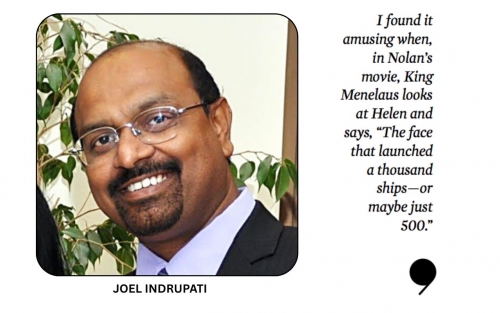
I found it amusing when, in Nolan’s movie, King Menelaus looks at Helen and says, “The face that launched a thousand ships—or maybe just 500.”
Actually, that famous line is not from Homer. It is from Christopher Marlowe’s Doctor Faustus (1604). Referring to Helen of Troy, it means that a woman can be so beautiful that her looks could start a massive war.
No retelling of an epic can ever be perfect. But if new generations must learn from the old, retelling and reinterpreting it is always good.
(The views and opinions expressed in this article are those of the author and do not necessarily reflect the official policy or position of the Daily Tribune)
Related Posts