

Four new elements complete seventh row of Periodic Table
Four new elements have been added to the periodic table, that finally filled the table’s seventh row, propelling science textbooks around the world to update instantly.
According to a report in The Guardian, the elements, discovered by scientists in Japan, Russia and America, are the first to be added to the table since 2011, when elements 114 and 116 were added.
The four reportedly were verified on 30 December by the US-based International Union of Pure and Applied Chemistry, the global organisation that governs chemical nomenclature, terminology and measurement.
IUPAC announced that a Russian-American team of scientists at the Joint Institute for Nuclear Research in Dubna and Lawrence Livermore National Laboratory in California had produced sufficient evidence to claim the discovery of elements 115, 117 and 118.
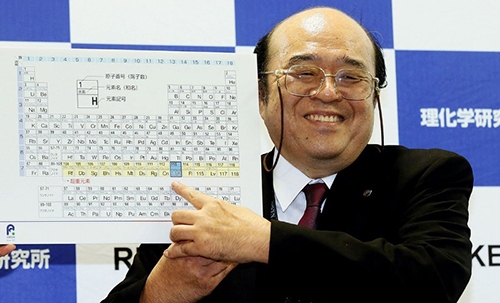
Kosuke Morita, who was leading the research at Riken, said his team now planned to “look to the unchartered territory of element 119 and beyond.”
Ryoji Noyori, former Riken president and Nobel laureate in chemistry said: “To scientists, this is of greater value than an Olympic gold medal”.
The elements, which currently bear placeholder names, will be officially named by the teams that discovered them in the coming months. Element 113 will be the first element to be named in Asia.
“The chemistry community is eager to see its most cherished table finally being completed down to the seventh row,” said Professor Jan Reedijk, president of the Inorganic Chemistry Division of IUPAC.
“IUPAC has now initiated the process of formalising names and symbols for these elements temporarily named as ununtrium, (Uut or element 113), ununpentium (Uup, element 115), ununseptium (Uus, element 117), and ununoctium (Uuo, element 118).”
New elements can be named after a mythological concept, a mineral, a place or country, a property or a scientist.
The four new elements, all of which are synthetic, were discovered by slamming lighter nuclei into each other and tracking the following decay of the radioactive superheavy elements.
Like other superheavy elements that populate the end of the periodic table, they only exist for fractions of a second before decaying into other elements.
The Guardian
Photo: Kosuke Morita who led the team of Japanese scientists researching element 113, welcomes its addition to the periodic table (newscientist.com)
Related Posts