

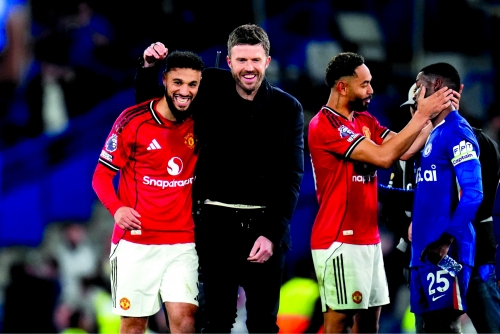
Is Carrick quietly winning the United job?
TDT | Manama
Email : hussainm@newsofbahrain.com
Michael Carrick is rapidly shifting the conversation around Manchester United’s long-term managerial plans. A 1-0 win over Chelsea has not only strengthened United’s push for Champions League qualification, but also raised an uncomfortable question inside the club: is the interim manager doing enough to keep the job permanently?
Appointed on an interim basis following a turbulent managerial change, the Englishman inherited a squad lacking cohesion, confidence, and tactical identity. While United’s hierarchy are still believed to be assessing more experienced candidates, his early results have forced internal discussions about whether continuity might now be the smarter option.
Controlled win at Stamford Bridge
Saturday’s victory over Chelsea was not a statement of dominance, but it was a clear demonstration of control under pressure.
Liam Rosenior’s side created the clearer chances and even struck the woodwork three times, yet United’s defensive organisation and game management allowed them to absorb pressure. That ability to stay controlled without dominating possession ultimately shaped the outcome, as they took their opportunity when it arrived.
The decisive moment came when Matheus Cunha finished first time from a Bruno Fernandes cut-back. In that sense, the Blues were punished for failing to convert their dominance into goals.
What stood out most was not attacking fluency, but structure without the ball. This was something United had frequently lacked earlier in the season, and its return has been significant.
Tactical discipline
Carrick’s most noticeable impact has been defensive stability. United looked compact in a midblock, with improved spacing between midfield and defence. As a result, the transitional chaos that had previously exposed them against top sides was significantly reduced.
This improvement came under difficult circumstances. Forced changes before kick-off increased the challenge, with Matthijs de Ligt absent, Lisandro Martínez and Harry Maguire suspended, and Leny Yoro also unavailable late on. Carrick was therefore forced to improvise a back line featuring Noussair Mazraoui and 19-year-old Ayden Heaven.
Even so, the response was encouraging. Heaven impressed on debut, showing composure in aerial duels and strong positional awareness. This also reflects Carrick’s willingness to trust younger players in high-pressure situations rather than defaulting to caution.
The case in Carrick’s favour
The strongest argument for Carrick is United’s improved results in big matches. They have remained unbeaten in fixtures against “Big Six” opposition under his interim tenure, which represents a clear shift from earlier inconsistency.
He has also simplified United’s structure. Instead of complexity, the emphasis is now on clarity. There are fewer risky build-up patterns, more direct progression, and improved game-state management.
In short, United look harder to beat, even when they are not at their most fluent.
The case against him
However, there are still important questions about sustainability and long-term ceiling.
United’s performances under Carrick have often lacked attacking control.
Even when results improve, dominance is not always present. Against Chelsea, they were second-best for long periods and relied heavily on defensive resilience rather than sustained control.
There is also the issue of sample size. A short-term uplift after a managerial change is not unusual, and elite clubs often see “new manager bounce” effects that fade over time.
Most importantly, the club is still reportedly considering more experienced managers. These candidates bring proven long-term records at the highest level, something Carrick does not yet have.
Verdict: a genuine debate emerging
With five matches remaining, United are in control of their Champions League qualification hopes. Carrick has stabilised the team during a volatile period, and that stability should not be underestimated.
However, whether that is enough for a permanent appointment depends on what the club values more. The choice is between short-term stability in the dressing room or long-term certainty under an elite-level manager.
Right now, Michael Carrick has not fully won the job, but he has done enough to make this a far less straightforward decision for Sir Jim Ratcliffe and his INEOS team.
Related Posts